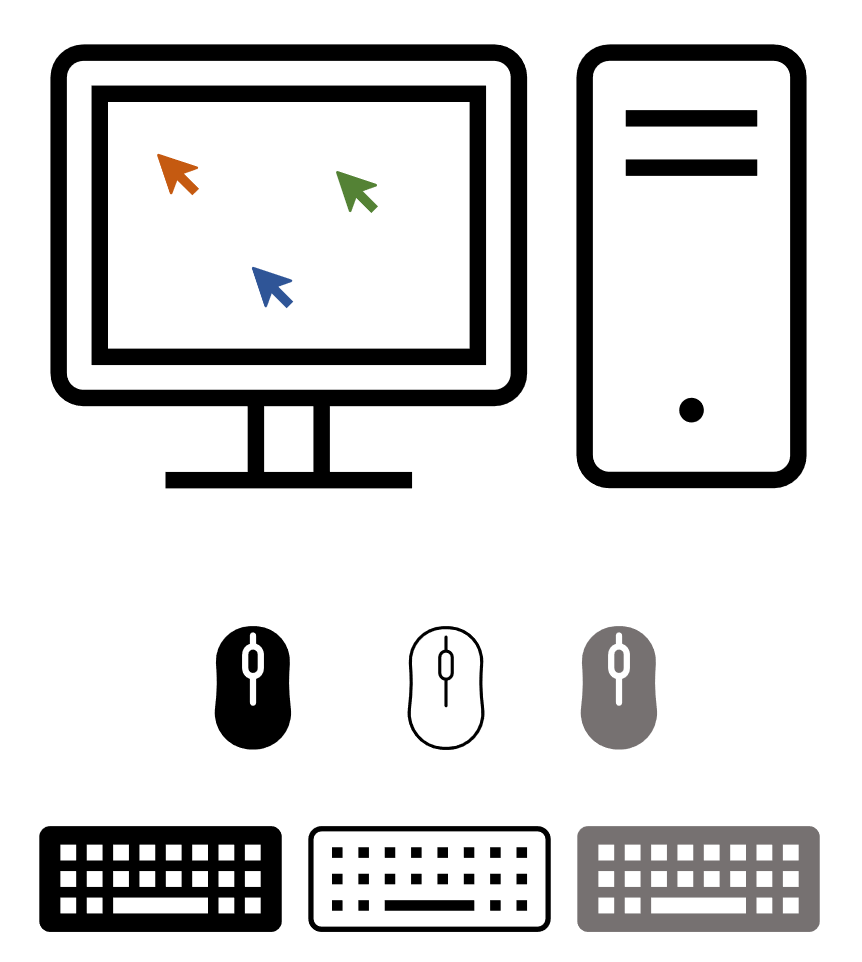
Each user gets their own cursor and can simultaneously work on the same Windows desktop. Configure each individual pointer device (acceleration, cursor theme, wheel and button behaviour etc) independently. Collaboration was never so easy!
Download (Or read some more on what features we have)
=
Multi-user Remote Desktop
Major updates to MouseMux! We now support RustDesk for multi-user remote desktop collaboration. This BETA includes new collaborative apps (Multi Paint, Team Vote, Whiteboard), smarter keyboard remapping, performance optimizations with cursor caching and high-DPI mouse support, a new Web SDK, and many bug fixes. As this is a beta release, you may encounter small inconsistencies. Your feedback is highly appreciated!
Our goal is to make working together as intuitive and simple as possible. Just add some extra pointer devices (mice, pens, touchpads) and (optional) keyboards and MouseMux will transform your PC into a realtime multi-user system. Each user can work in their own document, annotate on the screen, drag or resize windows or interact with different programs - all at the same time on the same windows desktop. Simple annotations allow each user to highlight parts of the screen. Concurrently interacting with different apps on the same desktop creates new and interesting ways to work together; collaborate by taking over certain actions, type together, draw together - all at the same time without interfering others.
Use it for pair programming, collaborative designing, in the class or meeting room (so all can interact and have a presence on the screen). Join forces on editing documents, or in the control room so each operator can see where the others are.
Use it to customize your mouse (or pen, touch or tablet) interaction; custom acceleration, assigned buttons, themes or wheel behavior - for each individual pointer device. Let any pointer device act as any other (mouse, pen, touch, etc). Record macro's and play them back to automate tasks, even in a multi cursor scenario. Having a cursor for each mouse means you can quickly interact with individual applications because cursors can be localized or dedicated to one program - the restriction of moving one cursor all over the screen and refocusing on a specific application is lifted. The screen's realastate becomes much more manageable.
In Industrial processes including manufacturing, process control, power generation, fabrication, and refining, and facility processes, including buildings, airports, ships, and space stations where multiple operators work in SCADA like situations safe multiuser operation is vital. MouseMux can manage individual users and can store historical data of any interaction. Assigning a supervisor and overriding actions by other operators is now possible - SCADA programs can integrate with our SDK so true simultaneous interaction becomes possible.
This separation creates the classic Japura tragedy: the Internship Breakup . It is a recognizable genre. The boy who used to wait by the gate for his girlfriend now finds his texts answered with single-word replies during her lunch break. The girl who organized flash mobs for his birthday now finds herself explaining to her corporate mentor that the “ragged boy” on her Instagram is just a “faculty friend.” The romance that thrived on proximity—on the shared misery of a bad lecture and the joy of a stolen isso wade —fails the long-distance test of the commercial world. Yet, Japura is a place of survivors. Beyond the fleeting flings and the internship tragedies, there exists a higher form of relationship: the Strategic Alliance , or what students call the “Batch Couple.”
To understand romance at Japura Kella, one must first understand its geography. The campus is a study in contrasts: the manicured lawns of the Humanities and Social Sciences faculty face the functional, high-pressure corridors of the Management and Commerce faculty. The Science faculty, with its perpetual odor of formaldehyde and its grueling lab hours, exists in its own temporal bubble. This physical layout creates rigid tribal boundaries. A relationship between a “Management boy” and an “Arts girl” is not just a personal affair; it is a cross-border diplomatic negotiation. Japura Campus Kella Explain About Sex In Sinhala Part 03
This public pressure cooker creates a specific narrative arc. Most Japura love stories are crisis-driven. Because there are no dorms to hide in, a fight between partners becomes a spectacle witnessed by 200 peers in the lobby. To survive, couples must develop a thick skin and a quick wit. The successful Japura relationship is one that learns to weaponize the crowd, turning the faculty mates from judges into cheerleaders. If public scrutiny is the forge of Japura romance, the internship year is the crucible that breaks it. The Sri Lankan university system’s structure (often a four-year degree with a mandatory internship or practical training in the penultimate year) serves as a brutal demographic reaper. Suddenly, the Management student who spent three years perfecting the art of the “library glance” is shipped off to a corporate office in Colombo, donning a starched white shirt and a lanyard. The Science student remains behind, buried in final year projects. This separation creates the classic Japura tragedy: the
These are the romances that have cleared the filters. They survive the internship separation. They survive the final year thesis. By the time graduation approaches, the relationship is no longer just emotional; it is logistical. These couples have already met each other’s parents, discussed lagna patra (horoscopes), and calculated the dual income potential of a Management graduate with a Business Analyst girlfriend. The Japura love story, at its most mature, is a masterclass in risk management. You don’t just fall in love at Japura; you invest in a partner who can survive the Kella traffic, handle the faculty gossip, and land a job at a Big Four firm. Finally, the essay must acknowledge the external pressure of “Kella” itself. The campus gate opens directly onto one of the busiest transport hubs in Colombo. The relationship that ends at graduation often dies at the Kella junction. The boy walks left to catch the 138 bus towards Maharagama; the girl walks right towards the Kelani Valley railway line. The cacophony of horns and the smell of diesel exhaust drown out the final "I’ll call you." The girl who organized flash mobs for his
In conclusion, the relationships of Japura Campus Kella are a microcosm of modern Sri Lankan youth culture. They are not the romantic idealism of a Bollywood film. They are raw, pragmatic, and brutally public. They are stories of surviving the commute, surviving the gossip, and surviving the clock. To have a successful romance at Japura is to prove that you can handle life itself—messy, loud, and accelerating towards the future at the speed of a bus leaving the Kella stand.
But the ones who don't part? They cross the street together. They walk into the Kella traffic as a unit. They have learned, over four years of navigating the chaos of lectures, the cruelty of the rumor mill, and the pressure of internships, that the world outside is just a larger, less forgiving version of the campus.
The archetypal Japura romance often begins not with a swipe on a dating app (though those exist as a parallel universe), but with an “accidental” eye contact during a prayogashalawa (workshop) or a shared complaint about the queue at the photocopy machine. Because the campus lacks the residential “hostel culture” of Peradeniya or Ruhuna, students are commuters. This transience forces romance to become highly efficient. There is no midnight poetry under a banyan tree; instead, there is the strategic “borrowing of notes” that stretches into a shared cup of tea at the kade near the Kella junction. In the Japura ecosystem, the public gaze is both a weapon and a stage. The infamous “Japura Gossip” Facebook groups and anonymous WhatsApp forwards serve as the Greek chorus of modern campus romance. A couple holding hands near the main library is not merely a couple; they are data points for the rumor mill. Consequently, a unique choreography of intimacy has evolved. The “Canteen Walk”—where a boy and a girl walk exactly three feet apart, pretending not to know each other until they reach the relative anonymity of the crowded canteen—is a rite of passage. The ultimate display of commitment is not a proposal, but the public admission of the relationship during avurudu (Sinhala New Year) games, where the entire faculty watches as they tie the kana mutti together.

This separation creates the classic Japura tragedy: the Internship Breakup . It is a recognizable genre. The boy who used to wait by the gate for his girlfriend now finds his texts answered with single-word replies during her lunch break. The girl who organized flash mobs for his birthday now finds herself explaining to her corporate mentor that the “ragged boy” on her Instagram is just a “faculty friend.” The romance that thrived on proximity—on the shared misery of a bad lecture and the joy of a stolen isso wade —fails the long-distance test of the commercial world. Yet, Japura is a place of survivors. Beyond the fleeting flings and the internship tragedies, there exists a higher form of relationship: the Strategic Alliance , or what students call the “Batch Couple.”
To understand romance at Japura Kella, one must first understand its geography. The campus is a study in contrasts: the manicured lawns of the Humanities and Social Sciences faculty face the functional, high-pressure corridors of the Management and Commerce faculty. The Science faculty, with its perpetual odor of formaldehyde and its grueling lab hours, exists in its own temporal bubble. This physical layout creates rigid tribal boundaries. A relationship between a “Management boy” and an “Arts girl” is not just a personal affair; it is a cross-border diplomatic negotiation.
This public pressure cooker creates a specific narrative arc. Most Japura love stories are crisis-driven. Because there are no dorms to hide in, a fight between partners becomes a spectacle witnessed by 200 peers in the lobby. To survive, couples must develop a thick skin and a quick wit. The successful Japura relationship is one that learns to weaponize the crowd, turning the faculty mates from judges into cheerleaders. If public scrutiny is the forge of Japura romance, the internship year is the crucible that breaks it. The Sri Lankan university system’s structure (often a four-year degree with a mandatory internship or practical training in the penultimate year) serves as a brutal demographic reaper. Suddenly, the Management student who spent three years perfecting the art of the “library glance” is shipped off to a corporate office in Colombo, donning a starched white shirt and a lanyard. The Science student remains behind, buried in final year projects.
These are the romances that have cleared the filters. They survive the internship separation. They survive the final year thesis. By the time graduation approaches, the relationship is no longer just emotional; it is logistical. These couples have already met each other’s parents, discussed lagna patra (horoscopes), and calculated the dual income potential of a Management graduate with a Business Analyst girlfriend. The Japura love story, at its most mature, is a masterclass in risk management. You don’t just fall in love at Japura; you invest in a partner who can survive the Kella traffic, handle the faculty gossip, and land a job at a Big Four firm. Finally, the essay must acknowledge the external pressure of “Kella” itself. The campus gate opens directly onto one of the busiest transport hubs in Colombo. The relationship that ends at graduation often dies at the Kella junction. The boy walks left to catch the 138 bus towards Maharagama; the girl walks right towards the Kelani Valley railway line. The cacophony of horns and the smell of diesel exhaust drown out the final "I’ll call you."
In conclusion, the relationships of Japura Campus Kella are a microcosm of modern Sri Lankan youth culture. They are not the romantic idealism of a Bollywood film. They are raw, pragmatic, and brutally public. They are stories of surviving the commute, surviving the gossip, and surviving the clock. To have a successful romance at Japura is to prove that you can handle life itself—messy, loud, and accelerating towards the future at the speed of a bus leaving the Kella stand.
But the ones who don't part? They cross the street together. They walk into the Kella traffic as a unit. They have learned, over four years of navigating the chaos of lectures, the cruelty of the rumor mill, and the pressure of internships, that the world outside is just a larger, less forgiving version of the campus.
The archetypal Japura romance often begins not with a swipe on a dating app (though those exist as a parallel universe), but with an “accidental” eye contact during a prayogashalawa (workshop) or a shared complaint about the queue at the photocopy machine. Because the campus lacks the residential “hostel culture” of Peradeniya or Ruhuna, students are commuters. This transience forces romance to become highly efficient. There is no midnight poetry under a banyan tree; instead, there is the strategic “borrowing of notes” that stretches into a shared cup of tea at the kade near the Kella junction. In the Japura ecosystem, the public gaze is both a weapon and a stage. The infamous “Japura Gossip” Facebook groups and anonymous WhatsApp forwards serve as the Greek chorus of modern campus romance. A couple holding hands near the main library is not merely a couple; they are data points for the rumor mill. Consequently, a unique choreography of intimacy has evolved. The “Canteen Walk”—where a boy and a girl walk exactly three feet apart, pretending not to know each other until they reach the relative anonymity of the crowded canteen—is a rite of passage. The ultimate display of commitment is not a proposal, but the public admission of the relationship during avurudu (Sinhala New Year) games, where the entire faculty watches as they tie the kana mutti together.
Proudly serving our clients! Let us know if you need a customized/branded version for specific corporate or industrial use.
We're looking for a passionate MouseMux enthusiast to help spread the word! If you love creating content (videos, tutorials, demos), engaging with communities, or just can't stop talking about multi-cursor collaboration, we want to hear from you.
We love people who think outside the box and can spot new opportunities where MouseMux could flourish - whether that's creative use cases, new markets, or ways to reach people who haven't discovered multi-cursor collaboration yet.